The Information Literacy programme at Maastricht University started around 2020. Since then, we have supported students and teachers and developed new Information Literacy materials.
Evaluation of your (AI-assisted) literature search
Explore our handout to
evaluate whether results from your (AI-assisted) literature search are trustworthy and appropriate for your research.
Teaching tools
The library supports students, but also teachers and researchers, in enhancing their Information Literacy skills. We are constantly developing and updating our tools. Reach out to us if you have any specific needs or questions.
Academic skills online modules
We have developed online modules on academic skills for Information Literacy. These can be used by students for self-study and for teachers to integrate in their courses.
Canvas course
We have developed a Canvas course for Information Literacy. This is for teachers and facilitates the integration of our Information Literacy materials into courses.
Information Literacy framework
Information is everywhere around us: from (digital) books and articles to social media notifications and videos. To define the skills and attitudes that students (and staff) require to navigate through such an information jungle, the UM developed a framework for Information Literacy for the PBL context. The Information-Wise project was a collaboration between the University Library, EDLAB, and faculties.
The UM Information Literacy framework presents the vision for an information literate bachelor student at our university.
The framework builds on the principles of PBL and entails four dimensions:
- Resource discovery,
- Critical assessment,
- Organising information,
- Creation & communication.
For each dimension, several online modules and teaching tools were developed.
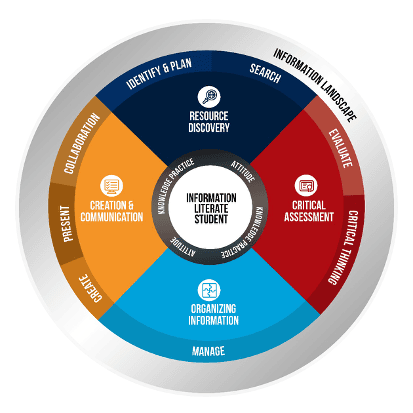
View a text description of the Information Literacy visual
Information Literacy visual description
Circular Information Literacy framework showing an information-literate student at the centre, surrounded by four interconnected skill areas: resource discovery, critical assessment, organizing information, and creation and communication. These involve identifying and planning, searching, evaluating, critical thinking, managing, creating, presenting, and collaborating within the information landscape. Knowledge practices and attitudes underpin the framework. More information can be found in the UM Information Literacy framework.
UM Rubric
In addition to the framework a rubric is available to create a shared understanding of what is expected from students at different levels of information literacy development.
The developmental rubric is structured into four levels: (1) Novice, (2) Intermediate, (3) Competent, and (4) Advanced (see the rubric). These levels demonstrate the differentiation of attitudes, knowledge level, and skills level between a novice and an advanced bachelor student in a specific area of information literacy.
A rubric manual outlines different scenarios for implementing the rubric ILOs into bachelor programs and courses, following the constructive alignment approach.
Contact
Please contact our library specialists through Ask Your Librarian:
- FASoS: Roberto Cruz Martínez
- FSE: Floor Ruiter
- LAW: Candan Yılmaz
- FPN: Rinus Verdonschot
- FHML / MUMC+ / AVM: Floor Ruiter, Remy van Alebeek and Maria Vincenti Gonzalez
- SBE: Angie Figueroa