
DOI
https://doi.org/10.26481/mup.2610
Published Online
29-09-2026
License
Creative Commons Attribution 4.0 International licence (CC BY 4.0)
Copyright
© 2026 The Authors and Maastricht University
Maastricht University Press
Open Access
This open access book is free to read online, download, and reuse.
You can also order a print version.

Book description
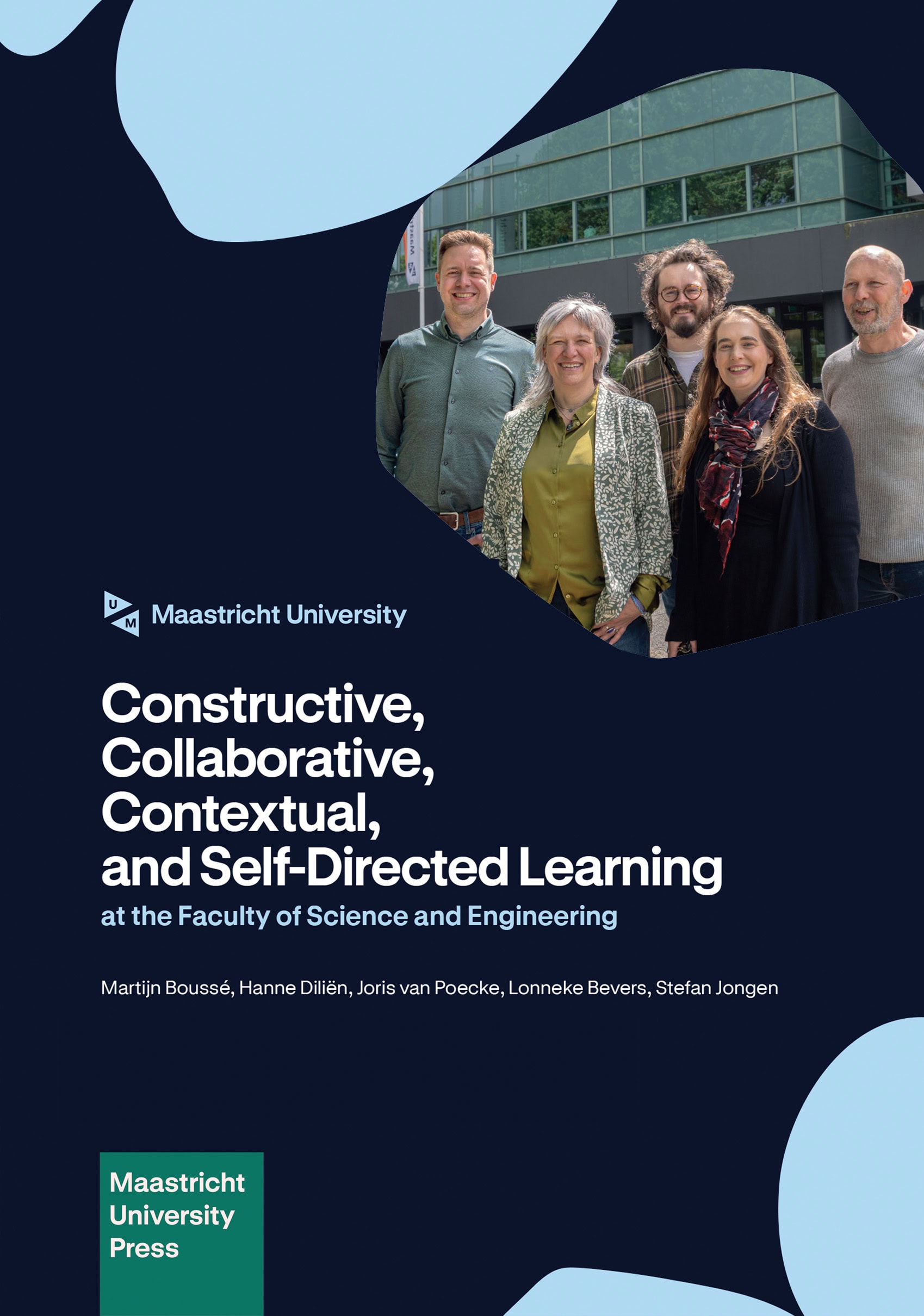
Problem-Based Learning (PBL) has shaped education at Maastricht University (UM) for more than five decades. Yet PBL is sometimes narrowly associated with one particular instructional format: the seven-step approach. Constructive, Collaborative, Contextual, and Self-Directed (CCCS) Learning at the Faculty of Science and Engineering (FSE) takes a broader perspective. It presents the four CCCS learning principles as a flexible set of design principles for meaningful teaching, learning, and assessment.
The booklet brings together more than thirty examples from across FSE. Organised around Science, Technology, Engineering, Arts, and Mathematics (STEAM), the cases span educational levels from pre-university education to PhD training and cover a wide variety of formats, including tutorials, laboratories, projects, fieldwork, assessment, games, and technology-enhanced learning.
Each case starts from an educational challenge, describes a concrete intervention, and reflects on the design through the CCCS lens. Readers encounter examples ranging from student-led mathematics tutorials and open-ended physics experiments to robotics projects, ecological fieldwork, co-created assessment, serious games, and authentic engineering challenges. Together, they demonstrate that student-centred learning can take many different forms while remaining academically rigorous and appropriate to the demands of STEAM education.
Rather than prescribing a single method, the booklet inspires educators to rethink their own practice. It shows how CCCS learning principles can serve as a shared language for educational innovation while allowing room for disciplinary differences, creativity, co-creation, playful learning, technology, and different approaches to PBL.
The collection is intended as a practical source of ideas for teachers, course coordinators, programme directors, educational developers, and University Teaching Qualification participants within Maastricht University and beyond. Its central message is simple: CCCS learning is not confined to one classroom format or one disciplinary tradition; it is a versatile foundation for designing engaging and meaningful higher education.
Key Features
- 30+ concrete educational cases demonstrating CCCS learning in practice.
- Full STEAM coverage, with examples from Science, Technology, Engineering, Arts, and Mathematics.
- Beyond the seven-step approach, illustrating the diversity and flexibility of Problem-Based Learning.
- Practice-oriented format, with each case structured around an educational challenge, an intervention, and reflection through the CCCS lens.
- Wide variety of educational formats, including tutorials, laboratories, projects, fieldwork, assessment, games, co-creation, and technology-enhanced learning.
- Broad educational range, with examples spanning pre-university education, bachelor’s and master’s programmes, and PhD training.
- Designed for transfer, offering ideas that educators can adapt to their own courses, programmes, and disciplinary contexts.
- Useful for professional development, including teacher training, UTQ activities, educational workshops, and curriculum (re)design.
Target audiences and educational use
The primary target audience consists of higher education teachers, tutors, course coordinators, programme directors, educational developers, and others involved in designing or improving teaching, learning, and assessment. The booklet is particularly relevant to educators working in Science, Technology, Engineering, Arts, and Mathematics (STEAM), but the examples and underlying CCCS principles are transferable to other disciplinary contexts.
Within Maastricht University, the booklet can also support participants and trainers in teacher professional development, including the University Teaching Qualification (UTQ), as well as educational leaders and programme teams seeking practical examples of Problem-Based Learning and CCCS-informed educational design.
The booklet is intended primarily as an inspiration and professional development resource rather than a traditional textbook. Educators can use individual cases to explore how Constructive, Collaborative, Contextual, and Self-Directed (CCCS) learning principles translate into concrete teaching activities, assessment formats, projects, laboratories, and other educational settings.
The cases can be used individually for course (re)design or collectively in teacher training, workshops, curriculum development, and programme-level discussions. Their common challenge–intervention–CCCS reflection structure makes them particularly suitable for discussing educational design choices and adapting successful ideas to different disciplinary and institutional contexts.
Publication details and metadata
Title
Constructive, Collaborative, Contextual, and Self-Directed Learning
Subtitle
At the Faculty of Science and Engineering
Authors
Martijn Boussé (ORCID) – Maastricht University (ROR)
Hanne Diliën (ORCID) – Maastricht University (ROR)
Joris van Poecke (ORCID) – Maastricht University (ROR)
Lonneke Bevers (ORCID) – Maastricht University (ROR)
Stefan Jongen (ORCID) – Maastricht University (ROR)
Design and layout
Grafisch Ontwerpburo Emilio Perez
Published by
Maastricht University Press | Maastricht University, Maastricht, the Netherlands
DOI (digital version)
https://doi.org/10.26481/mup.2610
Published On
29 September 2026
Copyright
© 2026 The Authors and Maastricht University
License
Creative Commons Attribution 4.0 International licence (CC BY 4.0)
Third-party content – Note on images/photographs
ISBN
Soft Cover: 9789403929699
Access to this publication
Download: https://umlib.nl/mup.2610.pdf
Read Online: https://umlib.nl/mup.2610.flip
Purchase a copy: https://umlib.nl/mup.2610.pbck
Publication Type and Language
Book – English
Subject
Education
Keywords
Problem-Based Learning, higher education, STEAM Education, constructive learning, contextual learning, collaborative learning, self-directed learning, active learning, assessment, educational innovation
Audience
Citation for this work
Boussé, M., Diliën, H., van Poecke, J., Bevers, L., & Jongen, S. (2026). Constructive, collaborative, contextual, and self-directed learning: At the Faculty of Science and Engineering. Maastricht University Press. https://doi.org/10.26481/mup.2610
Other versions and related works
Statistics
Overview of total views and downloads. Statistics are updated monthly
- Page views:
- Paper downloads:
Last update:
