
When we want to understand the mind, whom do we trust?
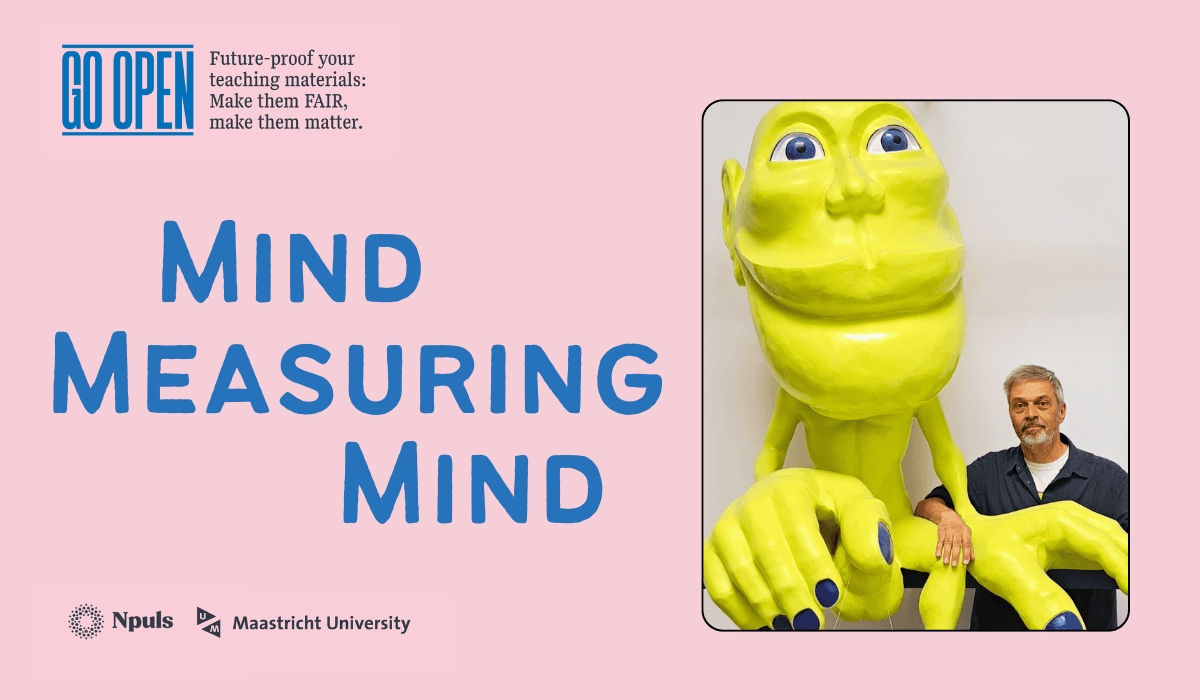
In the photograph accompanying this article, Garmt Dijksterhuis stands beside a bright yellow sensorimotor homunculus: a strange-looking figure whose oversized lips and hands reflect how much brain space is devoted to those sensitive body parts. One is a human psychological scientist. The other is a creature of nerves and brain maps. Together, they ask a surprisingly difficult question: when we want to understand the mind, who do we trust?
That question sits at the heart of Garmt’s open textbook, funded by the Maastricht University Library’s OpenUP grant. As he describes it, we can ask a person questions in countless ways, but can we trust the answers, even when that person believes they are telling the truth? Yet turning to the body and the brain does not solve everything either. Nerves may fire, signals may flash, but do they tell the truth any more clearly?
This is the challenge that fascinates Garmt. A psychological scientist with a background in experimental psychology and a PhD in applied statistics for sensory science data, he has spent decades working on perception and behaviour across universities, research institutes, and industry. At Maastricht University, he now brings that experience into education.
Opening up psychological science education
His open textbook introduces students to psychological science and research in a way that is both grounded and reflective. It explores methodology, ethical research practice, and the challenges of measuring behaviour and mental processes in a Problem-Based Learning context. Or, as Garmt puts it more sharply, psychology is a “self-involved science”: you use your own mind to measure other minds.
For Garmt, that is not something students can fully grasp from theory alone.
“Only through participating you know what an experimental subject experiences. It’s the only way to find out about all the details that can go wrong in experiments with humans.”
That same spirit carries into the decision to make the textbook open. Rather than keeping valuable teaching material within a single programme, Mind Measuring Mind is available for wider sharing. That means other educators can learn from it, other students can benefit from it, and the conversation around how we teach psychological science can keep growing.
With this open textbook, Garmt is not only supporting a course. He is helping to shape a future in which educational materials are more accessible, reusable, and connected to real-world scientific practice. In that sense, Mind Measuring Mind is both a textbook and an invitation: to question carefully, to measure thoughtfully, and to learn by doing.
Published as an open textbook by Maastricht University Press, Mind Measuring Mind: An introduction to psychological science and research is freely available for anyone to read and reuse online: https://doi.org/10.26481/mup.2605
Read or download the book?
Want to publish a (text)book?
Further reading
Thanks for reading our posts. We would like to hear from you.
- Need help? Please use our Ask Your Librarian service for prompt answers to concrete questions and issues.
- Want to stay informed? Subscribe to our monthly Research Support Update to stay informed about changes and updates.
- We’re on LinkedIn! If you like to promote our books, please like, comment or share our posts. And while there, follow Maastricht University Press and invite your network
0 Comments