
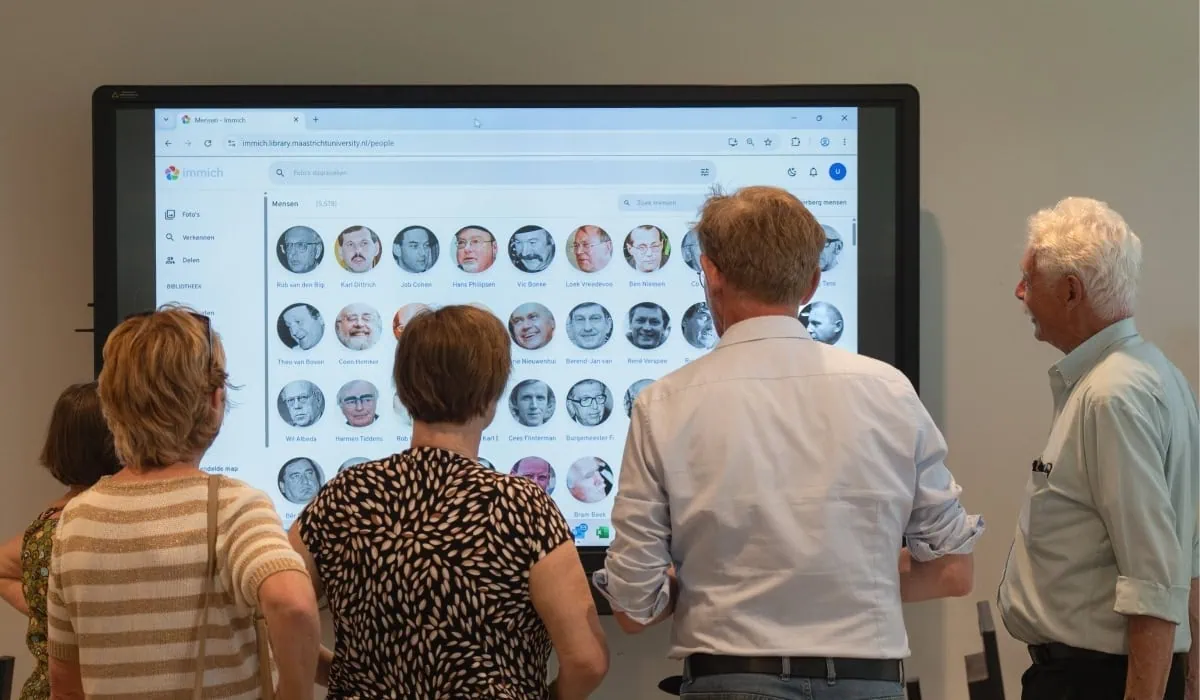
In phase 1 of the project, a collection of historical photographs of UM buildings was made publicly available through the library’s Digital Collections platform. Phase 2 builds on this by focusing on making the photographs FAIR (Findable, Accessible, Interoperable, Reusable) through a series of FAIRification sessions in which current and former UM employees help identify people, places, and stories captured in the images. By doing so, they contribute valuable knowledge that supports metadata enrichment and long-term accessibility of the collection. These sessions are being conducted with financial support from the FHML50 Years Ahead in Health project, FHML’s faculty initiative for Maastricht University’s 50th anniversary year.
Memories behind the images
Looking at an old photograph can bring back more than just a name. It can reveal memories of the people, places, and moments that shaped Maastricht University in its early years. During the first Photo FAIRification session, former UM employees came together to look through historical images and help add missing information to the collection. Names were recognised, stories resurfaced, and small details suddenly became part of a much larger history.
A collection from UM’s early years
The collection covers the period from 1975 to 2003 and shows events, people and buildings connected to the development of the Rijksuniversiteit Limburg into Maastricht University. The archive was formerly managed by UM’s Archive, Documentation and Postal Affairs department (ADP) and is now held by Maastricht University Library. Through this project, Maastricht University Library is not only preserving photographs, but also the knowledge connected to them. By documenting names, events and personal stories, the library helps ensure UM’s institutional memory remains accessible for future generations of students, researchers, teachers, and staff.
For the participants, this session was not only about recognising faces, but also about revisiting an important part of UM’s early history.
Why this knowledge matters
Gerard Majoor, who started working at what was then still a medical faculty in development in 1974, described the experience as a form of nostalgia. “It is very special to look back at photos from the early days,” he explained. “At the same time, it is important that the library is doing this now. In ten years time, some of this knowledge may no longer be available.”
The photos also brought back unexpected memories. One image from 1983 showed Majoor in a tutorial group, wearing a tie. “I never wore a tie,” he laughed. “But the proof is there.” Small details like this show how the photo collection can reveal both personal stories and broader institutional history.
Cintha, who worked at the university from 1981 to 2024, remembered the early years as a time when the university still felt small and familiar. “It was a very nice time. Everything was still small, and you knew many people,” she said. For her, the value of the collection lies in being able to see who contributed to the university over the years.
Combining technology and personal stories
According to project coordinator Maryam Mazaheri (Product Owner Linked Open Data – CM Interoperability at UM Library), many photos still lack contextual information. By combining technological support with the knowledge of people who were part of UM’s history, the library hopes to enrich the collection step by step. The project team is also experimenting with a test system that uses AI-assisted facial recognition to group photographs of individuals identified by the system as the same person. Once a person has been identified, this can help apply that information across related photographs, supporting both the identification process and more efficient metadata enrichment. However, technology cannot do everything, and the knowledge and memories of former and current UM employees remain essential for adding context, stories, and historical meaning to the photographs.
Join a future session
More sessions will be organised throughout the jubilee year. People who were involved with Maastricht University between 1975 and 2003 are warmly invited to join and help preserve this shared history.
Interested in participating? Register your interest via the form and help us add names, stories and context to UM’s historical photo collection.
0 Comments