<intro-tekst volgt nog>




Collections
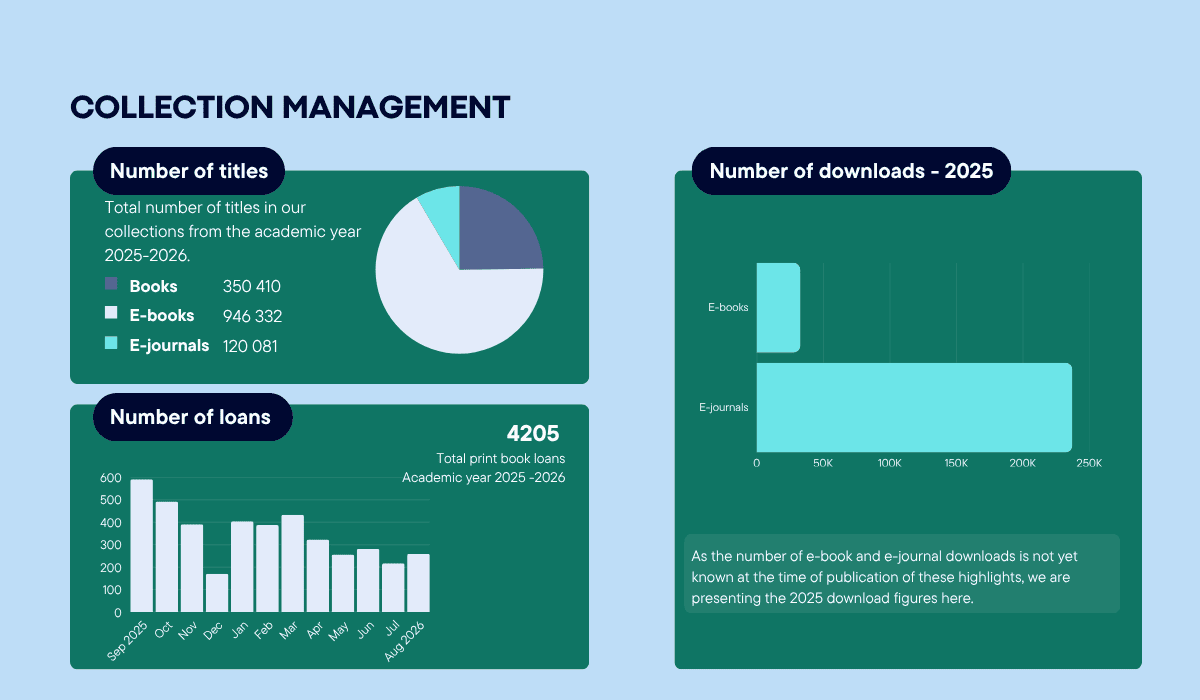
Scientific information remains at the core of Maastricht University (UM) Library. Throughout 2026, the library continued to improve access to academic resources and develop its collections to meet the changing needs of education and research, guided by the new Strategic Collection Plan 2026-2031 and in close collaboration with faculties.
In line with this plan, the library developed retention criteria for journals, which enabled the removal of 6900 journal volumes from the collection, freeing up approximately 231 meters of storage space. An internally developed Universiteitsbibliotheken & Koninklijke Bibliotheek (UKB) tool also streamlined checks for the last remaining copies of books and journals in the Netherlands, making the process of an up-to-date collection more efficient. Several other process improvements have also made the library’s services more efficient. Purchase requests for educational materials are now processed within one working day, with 90% of materials available within two weeks. To contribute to more efficient and reliable thesis processing across UM, further improvements were made to the UM Theses Database, focusing on aligned submission procedures and strengthening collaboration between faculties and the library.
Maintaining diverse and inclusive collections is another priority of the Strategic Collection Plan. In collaboration with Maastricht Young Academy (MYA) and Lumière, the library organised a screening of The Librarians: Who decides what we read, a documentary exploring censorship, freedom of information and the role of libraries in ensuring access to diverse perspectives.
Expanding VR applications
Alongside updating its existing collections, the library expanded its range of digital learning resources with two VR applications, Enatom and VirtualSpeech. Available through the Digital Labs, these applications allow students to explore human anatomy and practise presentation skills beyond the classroom.
Beyond UM
The library explored how scientific information can be made more accessible to professionals outside academia. Through the Wetenschap voor beleid project, the library worked with policymakers from the Province of Limburg and municipalities involved in the Brightlands campuses. The project was funded by PICA, a Dutch foundation supporting innovation and access to information in the library sector. It resulted in a practical list of openly accessible scientific sources to support evidence-based policymaking.
The library’s commitment to Open Science also led to a new partnership with OpenAlex, supporting open research information in line with the Barcelona Declaration. To simplify access to scientific publications, the library introduced two browser extensions, Lean Library and LibKey Nomad, helping students and researchers find and access academic resources directly from their browsers, wherever they work.

Special Collections
From exhibitions to educational activities, 2026 offered many opportunities to discover and engage with UM’s Special Collections. A look back at this year’s activities shows how these historical collections were made more visible and accessible. These initiatives offer new ways to explore the university’s cultural heritage and use historical sources in education and research.
Preserving this heritage is equally important. During the National Action Days for Resilient Heritage, the library highlighted its efforts to protect historical collections through improved emergency preparedness and collection care.
Alongside these preservation efforts, the collections were presented in new ways. A digital exhibition on military memory tourism, developed by a UM student, brought historical travel guides to life through interactive maps and multimedia. Meanwhile, Books, Takes & Tiny Worlds combined historical fairy-tale books with contemporary artworks.
The library also brought its Special Collections to a wider audience. A six-month programme, invited visitors to engage with historical collections in a different setting. As part of the UM’s 50th anniversary, guided tours offered a closer look at the Special Collections, attracting regional media attention. Meanwhile, the UM50 History Clinic invites people to share personal memories and contributes to the university’s history.


Research support
This year, UM Library strengthened its research support services, improving the visibility of research outputs, secure data storage and research collaboration.
An important step was made in increasing visibility and findability of Non-Traditional Research Outputs (NTROs), such as research data, research software and research activities. As part of the Open Science NL-funded project Recognising and Rewarding Open Science, researchers were encouraged to register these outputs in Pure, the Current Research Information System (CRIS), supported by improved Pure manuals and a targeted campaign at Faculty of Health, Medicine and Life Sciences (FHML). Automatic imports of datasets and software simplified registration, while the Research Intelligence dashboard now provides insight into NTROs at unit level.

The graph compares the academic years 2024–2025 and 2025–2026, showing a substantial increase in the cumulative number of records created at UM, particularly for activities and datasets.
The library’s data stewards and ICT Service Centre (ICTS) further developed the Storage Finder, helping researchers choose the most suitable option from the range of storage solutions available at UM.
One of these solutions is SURF Research Drive, which replaced the former Virtual Research Environment (VRE). This digitally sovereign storage solution supports secure data storage and collaboration with external partners, while maintaining control over their data. Researchers across all UM faculties now use the service.

Prof. Roy Erkens, PhD
Evolutionary plant biologist at System Earth Science in the Faculty of Science and Engineering at UM:
“The world is changing and we need to give more attention to data security. SURF Research Drive feels safe and trustworthy, and I believe UM is doing this well.”
The Research Computing Support (RCS) team helped researchers develop their research computing skills through an Introduction to SURF Research Cloud training. Participants gained hands-on experience with virtual computing environments and applications.
Copyright support was also strengthened for the wider UM community through the renewed Copyright Information Point (CIP). This service provides students, teachers, researchers and staff with access to practical information, tools and advice on copyright.


Education support
This year, UM Library continued to strengthen its support for teachers and educational support staff, helping them make effective use of digital teaching tools and supporting innovation in education.
Through a series of workshops on FeedbackFruits, Wooclap, and Turnitin, teachers and educational support staff explored how these tools can support student engagement, interaction, feedback, and assessment.
To further support teachers and educational support staff in their daily use of Canvas, the library introduced a new online Canvas training course, offering flexible, self-paced learning opportunities. In addition, two new Canvas tools, GradeLoader and Course2PDF, were introduced to simplify administrative tasks for course coordinators.
The library also hosted a meeting of the Canvas User Group Benelux, bringing together 35 colleagues from universities and universities of applied sciences. The meeting provided an opportunity to share knowledge and experiences, as well as explore ways to improve the use of Canvas in higher education.
The library also supports education through its Copyright Information Point. In collaboration with faculties, the library checks teaching materials for copyright compliance and ensures that any necessary adjustments are made in accordance with copyright regulations. Read more about the renewed Copyright Information Point in the Research support section.


Open Science in research
In 2026, UM Library continued to advance Open Science by supporting open research practices, strengthening collaboration and making research and its contributions more visible.
Support for FAIR research software expanded with the launch of the Programming CAFE community, bringing researchers and students together to share knowledge and develop programming skills through initiatives such as Programming on the Vlaai. The updated Research Data Management Code of Conduct provided further guidance on responsible research practices.
The library also continued to strengthen its contribution to Open Access publishing. Maastricht University Press, part of the UM Library, and the Open Access team contributed to Open Science NL-funded Diamond Open Access projects, supporting publishing without fees for authors or readers. By October 2026, Maastricht University Press had published 22 titles that year, including the textbook Improving Health Care with Clinical Prediction Models: From Idea to Impact. Explore the Maastricht University Press publication catalogue for more publications.
Beyond making research openly accessible, the library worked with People & Development (P&D) to explore how contributions to Open Science can be more broadly recognised and rewarded. The Recognising and Rewarding Open Science project focused on approaches to research assessment that go beyond traditional publication and citations metrics.
Another area of focus was the role of knowledge workers in research. An Open Science NL funded collaborative project, involving the library and several UM faculties, investigates their often-overlooked contributions to research.
The library also contributed to the first Open Science Festival Limburg, which brought together researchers and professionals to strengthen collaboration and knowledge exchange around Open Science. During the festival, Rector Magnificus Jan Smits signed the Barcelona Declaration on Open Research Information on behalf of UM, reinforcing its commitment to open and transparent research information. As one step towards fulfilling this commitment, UM Library invested in a partner subscription with OpenAlex, supporting greater openness and accessibility of research information.

Open Science in education
The library supports Open Science in education by promoting collaboration, knowledge sharing and the development of Open Educational Resources (OER). Through partnerships, grants and practical support, the library contributes to make educational materials more accessible, adaptable and reusable.
The library participated in the first Open Science Festival Limburg, bringing together researchers, educators, students and support staff to exchange ideas and explore interdisciplinary collaboration. See the Open Science in research highlight for more information about the Open Science Festival Limburg.
In education, the library continued to support teachers in developing and sharing open educational materials. An example in collaboration with EDLAB is the Linear Algebra Card Game, an interactive learning resource made openly available for teachers to reuse and adapt. The library supported its publication by providing guidance on licensing, findability and accessibility.
The OpenUP grants, which are made possible by Npuls, further encouraged the development of open, accessible and reusable educational resources. Across two funding rounds, teachers received support to turn innovative teaching ideas into resources that can be shared beyond their own classrooms.
Projects included hands-on psychology experiments, interactive legal learning materials and conversational exam preparation tools. The second funding round selected twelve additional initiatives, which will be developed in 2027, broadening the range of openly available teaching materials across disciplines.

Citizen Science
UM Library expanded its support for Citizen Science, an approach within Open Science that brings researchers and members of the public together to contribute to scientific research. Through collaboration, knowledge sharing and practical guidance, and partly supported by funding from Open Science NL (OSNL), the library helped strengthen Citizen Science initiatives. One example was the launch of the Cititzen Science Hub De BRUG, a regional partnership connecting researchers and citizens around key societal themes such as nature and environment, health and well-being, and cultural heritage.
Citizen Science also featured prominently at the Open Science Festival Limburg. UM Library contributed to the festival, co-organised by the Open Science Community Maastricht, which included a keynote by Margaret Gold (coordinator of the national Citizen Science Netherlands network) on Citizen Science and transdisciplinary research.
To provide further practical support, the library developed a new Citizen Science best practices guide, bringing together useful advice and examples to help researchers set up and carry out their own projects.


Linked Open Community
Throughout 2026 UM Library continued to foster an environment that brings students, researchers and teachers together through its services, facilities and activities. By helping students find their way around the library and organising events that encourage interaction and knowledge sharing, the library contributed to an accessible and connected UM community.
Information services for students
In 2026, the library increased its presence during faculty introduction programmes and participated in INKOM, where students were encouraged to connect with the library on Instagram in exchange for a unique UM Library card game. This initiative helped strengthen the library’s direct engagement with students through social media. The newly introduced Library Tours offered another opportunity for students to explore the library and discover its facilities and services. This activity helped students find their way around the library at an early stage of their studies.
Initial experiences indicate that first-year students are finding the library locations more easily.
Events
UM Library organised and contributed to various events that encouraged knowledge sharing, dialogue and community engagement.
On 1 June, the library raised the Pride flag to express its support for diversity and inclusion and this year’s UM theme, Unity. This theme was brought to life during the Living Library event in October, organised in collaboration with UM’s Diversity, Equity and Inclusion+ Office. During the event, visitors engaged in personal conversations with people whose experiences and perspectives may differ from their own.
As part of Maastricht University’s 50th anniversary celebrations, several initiatives highlighted the university’s history and heritage, making it more accessible to the UM community and beyond. Two UM employees, including a library colleague, developed the Maastricht University Tour. This self-guided walking route takes visitors past 13 university buildings in the city centre, offering insights into their history, architecture and heritage. The FAIRification sessions brought current and former UM employees together to help identify and document historical photographs from the university’s archives.
In addition, events centred around UM’s Special Collections offered opportunities to explore cultural heritage, while the film screening in collaboration with Maastricht Young Academy brought together the community to reflect on how political and societal developments could influence a library’s collection management. The Research Computing Support (RCS) team also brought researchers together through an Introduction to SURF Research Cloud training session, combining hands-on experience with virtual computing environments and applications with opportunities for knowledge exchange.


Digital information literacy and AI
UM Library expanded its offer of online modules, workshops and resources to support students, teachers and researchers in developing Digital Information Literacy and AI skills. The educational offer continued to evolve in response to technological developments, with a focus on critical thinking and responsible AI use in education and research. Explore the available academic skills modules.
An important development was the continued work on the Digital Literacy Competence Framework for Students, identifying essential competences in consultation with UM faculties. The Month of Digital Fitness raised awareness of digital sovereignty, complemented by a hands-on workshop helping teachers make informed choices about digital tools. The Deep Dive into Digital Literacy video further highlighted the importance of these skills.
Responsible AI use remained a key focus. A collaborative project on AI-assisted literature searching resulted in a dedicated prompt and a practical handout, incorporated into an improved workshop and a new online learning module on searching literature with AI. Further developments included the Basics of AI Literacy @ UM module and colleague contributions to the national Prompt Library.
For researchers, the library added a support service for ASReview, an active learning-based screening tool, and continued updating its AI in Reviews webinar to reflect current guidance on AI use in evidence synthesis.
Practical experimentation also played an important role. In collaboration with ThePlant@FASoS and IDEE, the Prompt Hackathon connects AI prompting with 3D printing, offering students and staff opportunities to explore new applications of these technologies.

Learning Spaces including Digital Labs
UM Library continued to develop its Learning Spaces and digital facilities to support education, research and collaboration. A key development was the introduction of the Digital Labs, bringing existing facilities together under one collective concept to make them more visible, accessible and connected.
Responding to a growing need for digital creation and experimentation, the Digital Labs offer spaces, technologies and support for students, teachers and researchers. Facilities include XR Labs, podcast & video studios, 3D printing, multimedia editing and equipment lending. Together, they provide opportunities to explore emerging technologies and apply them in teaching, learning and research.
Alongside these facilities, the library strengthened its support for educational innovation. In collaboration with DEXLab, the library developed VR workshops for teachers, combining hands-on experience with guidance on the meaningful integration of immersive technologies into education.
During the 2026 UM Education Days, library colleagues shared practical approaches to educational innovation through workshops on VR and Generative AI. These sessions helped teachers explore how emerging technologies can enrich teaching while encouraging their critical and responsible use.
The UM community also contributed to the ongoing development of library locations. Through initiatives such as the PREMIUM project (part of UM’s Honours programme), students were actively involved in exploring how learning spaces could better respond to their needs and experiences. Their input helps inform the further development of accessible and supportive study environments.


Linked Open Data
This year, UM Library continued to strengthen international collaboration and improve the accessibility and discoverability of its collections and metadata.
In September, the library, together with the Dutch Digital Heritage Network (NDE), organised the third Omeka S International Developer & Power User Event. The event brought together developers and experienced users to exchange knowledge, share experiences and collaborate on the further development of Omeka S. As an open-source platform developed through community collaboration rather than reliance on a commercial provider, Omeka S supports digital sovereignty by giving institutions greater control over their digital infrastructure.
The library is working towards publishing its datasets in the national Dataset Register of the Dutch Digital Heritage Network (NDE), making them findable and reusable across the Dutch heritage sector. In preparation for NDE’s updated requirements, which take effect next year, the library’s Linked Open Data is being aligned with the revised NDE application profile.
The value of discoverability is already clear: several international researchers recently contacted the library about using parts of its Special Collections, interest partly generated by the collections’ online visibility through Omeka S. The Dataset Register extends that reach from a single platform to the wider heritage network.
